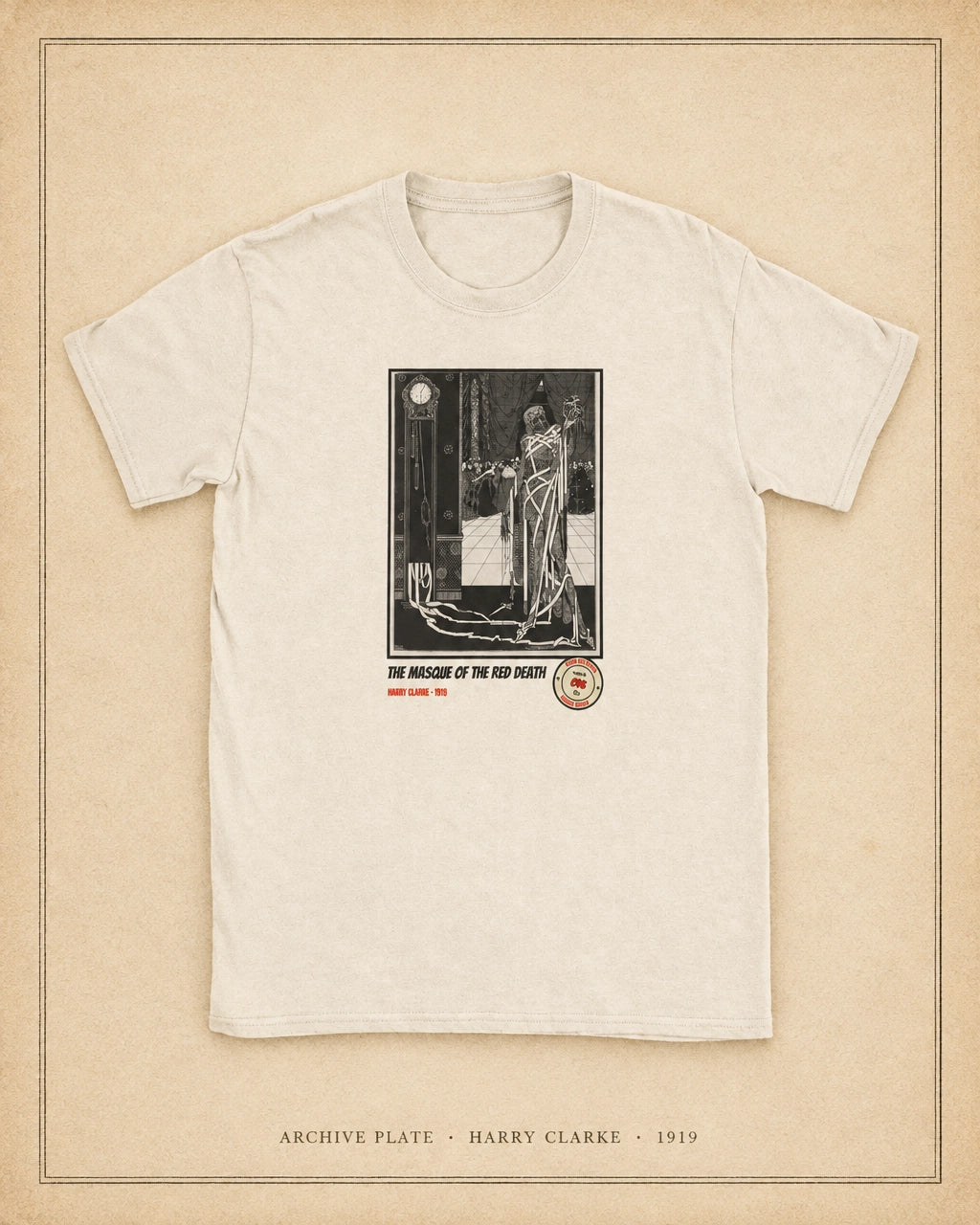
Harry Clarke (1889–1931) was an Irish stained-glass artist and book illustrator from Dublin. His illustrations are best known for their intricate black ink, elongated figures and eerie, jewel-like detail. In the 1919 Harrap edition of Edgar Allan Poe’s Tales of Mystery and Imagination, he turned gothic stories into densely framed, unforgettable visions of beauty and dread.
A century on, Clarke’s images still feel like something glimpsed by candlelight: intricate, theatrical and just a little unsettling. He could make a page look at once like a book illustration and a window into another, darker world. That’s why a Harry Clarke illustration can stop you mid-page, and why these images look just as arresting on a shirt as they do in a book.
The 1919 book that brought Clarke and Poe together
Clarke’s best-known illustration work for Edgar Allan Poe appeared in Tales of Mystery and Imagination, published by George G. Harrap in 1919. Bibliographical accounts describe the edition as containing 24 full-page black-and-white plates, alongside other decorative elements. These images don’t simply retell the stories. They capture their moods: dread, obsession, death and the uncanny.
The pages are densely composed, with fine lines, decorative borders and figures that seem to emerge from darkness. Clarke’s images make the book feel like an object from Poe’s own imaginary world. A handsome volume with something sinister behind its covers.
The book helped establish Clarke’s reputation as a book illustrator. His later projects included Goethe’s Faust (1925) and Swinburne’s Selected Poems (1928). For a closer look at the edition’s history and contents, see the Ulysses Rare Books description of the 1919 volume.
What makes a Harry Clarke illustration so distinctive?
Clarke’s style balances precision and unease. At first glance, the pictures can seem almost ornamental: the lines are controlled, the details abundant, the compositions elegantly framed. Look longer, though, and the beauty starts to feel unsettling. Figures stretch and twist; shadows become patterned spaces; a face or gesture can carry the whole scene’s menace.
Several qualities make the work instantly recognisable:
- Ink-black contrast: dark masses and delicate white lines give the compositions a striking, almost carved appearance.
- Elongated, androgynous figures: characters often seem graceful and otherworldly rather than naturalistic.
- Art Nouveau and Decadent influence: flowing forms, rich ornament and stylised bodies heighten the atmosphere.
- A stained-glass sense of structure: borders, panels and carefully contained shapes make the page feel constructed, almost luminous, even when the subject is grim.
That last quality makes sense in light of Clarke’s other work. He trained in his father Joshua Clarke’s stained-glass studio, Joshua Clarke & Sons, and created windows for churches around Ireland. In his book illustrations, you can feel a similar instinct for framing and pattern: a scene enclosed within a design, with light and darkness working together.
Three Poe images that keep their spell

In “The Cask of Amontillado,” the setting itself becomes part of the horror. Clarke’s chained figure and close, underground space make the scene feel airless, as though the walls are pressing in. The image is a fitting choice for readers who love Poe’s slow-building dread. You can see the archival artwork on The Cask of Amontillado – Harry Clarke, 1919.

“Ligeia” leans toward the dreamlike and spectral. Its tall, stylised figure and intricate setting give the image a hypnotic quality, as if it belongs to a vision rather than a waking room. Clarke’s control of detail is especially effective here: ornament makes the scene beautiful, while the story’s unease lingers beneath it. Explore Ligeia – Harry Clarke, 1919.
In “The Masque of the Red Death,” the contrast between ceremony and mortality is central. Clarke’s image preserves the story’s theatrical tension: the revelry is frozen in place, while death’s presence remains impossible to ignore. The plate is available on The Masque of the Red Death – Harry Clarke, 1919.
From book plate to wearable art
The original Poe illustrations are public domain, and they’re the source artwork for our Harry Clarke tees. We reproduce the period images from archival scans, keeping the focus on the dramatic compositions and fine detail that made the 1919 plates memorable.
An Edgar Allan Poe shirt can be a simple way to wear your love of gothic literature, but Clarke’s illustrations bring another layer: they’re also a piece of early twentieth-century art and book history. Each design makes a different mood visible: claustrophobic dread, spectral beauty or dark theatricality.
The tees are printed to order on a soft, unisex crewneck, with sizes from S to 3XL. If you’d like to browse more period-inspired designs, explore our 1910s collection, The Decadent Line, where art, literature and the stranger corners of the past meet.

A note on the artist behind the nightmares
Clarke’s imaginative work was only one part of a demanding artistic life. He worked in the family stained-glass studio, and his windows can be found in churches across Ireland. The National Library of Ireland’s Harry Clarke Papers finding aid offers a useful starting point for exploring his papers and working life.
The Poe commission required sustained, intricate work, but it’s worth being careful about claims that it alone caused Clarke’s later health problems. Biographical accounts describe ill health over a longer period. For further context on the book and the artist’s career, the Edgar Allan Poe Society of Baltimore’s essay on Poe’s publishing history is a helpful resource.
Clarke’s illustrations endure because they make horror beautiful without making it safe. Their fine borders invite you in; their shadows make you wonder whether you should have stayed outside. That blend of elegance and unease is the lasting magic of Harry Clarke, and the reason the old plates still feel alive.
FAQ
Who was Harry Clarke?
Harry Clarke (1889–1931) was an Irish stained-glass artist and book illustrator from Dublin. He is widely known for his gothic, highly detailed illustrations, including the plates for Edgar Allan Poe’s Tales of Mystery and Imagination.
What is Harry Clarke best known for illustrating?
Clarke is especially well known for his 1919 illustrations for Poe's Tales of Mystery and Imagination. He also illustrated literary works including Goethe's Faust and Swinburne's Selected Poems.
How many plates did Clarke make for the Poe edition?
Bibliographical accounts describe the 1919 Harrap edition as carrying 24 full-page black-and-white plates, alongside other decorative elements.


